

'80s Nostalgia
If you were an '80s kid like myself, your weekends probably kicked off with Saturday morning cartoons from He-Man, Inspector Gadget, The Smurfs, G.I. Joe, Transformers, and DuckTales.
As soon as the cartoons ended, I'd be out on my BMX, tearing through the neighbourhood, hitting up the local milk bar and then off to the parks with friends or siblings while trying to pull off tricks on our bikes we'd seen on MTV (Music Television).
Running around outside until sunset, then came the ritual of hitting up Blockbusters for either renting two new releases or five weeklies at a discounted price. Binge-watching it all on the Saturday night, knowing we had to be in bed early on Sunday for school the next day. The perfect way to squeeze every bit of fun out of the weekend before the weekday grind kicked in!
We had our stash of board games, Transformer figures, and a lineup of GI Joe and TMNT action heroes, but, without a doubt, the best memories were all about video games. Everyone in the neighbourhood knew each other, and if we weren't tearing it up on our bikes, we were making the rounds from one friend's house to another, taking turns on each other's consoles.
I'll never forget my adult cousins' Atari 2600. I used to be obsessed with playing Pitfall!. I wasn't the greatest—I'd always die trying to jump over crocodiles—but those pixelated adventures left a lasting impression on me. It's funny how even the simplest games could create such deep memories back then!

The Evolution of 8-Bit: From Simple Beginnings to Gaming Giants
The '80s were dominated by iconic 8-bit consoles like the Atari 2600, Famicom/NES, and Sega Master System. Pixelated graphics and chiptune soundtracks turned a generation of gamers into die-hard enthusiasts. While limited in graphics, sound, and processing power, these constraints defined the gaming experience of the decade and pushed developers to their creative limits.

By the end of the decade, even handhelds like the Game Boy continued to use 8-bit hardware, which shaped the era's iconic pixelated visuals and soundtracks. Despite the limitations, these systems produced some of the most memorable games in history. Iconic titles like Super Mario Bros., The Legend of Zelda, Mega Man, and Castlevania were all products of this era, showcasing the innovative ways game developers made the most of the 8-bit systems.
During the decade, gaming evolved at a staggering pace. Comparing the pixelated simplicity of Pac-Man (1980) to Final Fight (1989) feels like two different worlds. Early on, arcade machines were limited to monochrome or basic colour palettes and minimal memory. Games like Pac-Man, with its basic maze design and simple gameplay, were revolutionary then. No one expected much more because the idea of more complex visuals and mechanics seemed out of reach.
By the time Final Fight came along in '89, advancements in microprocessors and graphics had turned arcade machines into powerhouses. They delivered vibrant visuals, detailed characters, and immersive environments, transforming gaming into something much bigger.
In a series of upcoming blogs, I'll explore each specific year from 1980 to 1989. I will highlight the standout games released each year and examine how gaming evolved throughout this incredible decade.
The Beginning Of The Decade

Rewind to 1980—the year I was born.
It was a time of bold fashion, booming pop culture, and exciting tech innovations. People rocked neon colours and big hair, think oversized blazers with shoulder pads.
At the same time, music legends like Queen, Blondie, and Michael Jackson were on fire, and Star Wars: The Empire Strikes Back hit cinemas in May, blowing up the box office. Classics like Caddyshack and The Shining also made their debut that year.
The Sony Walkman changed how we listened to music on the go. Shopping malls became hotspots for teens to hang out, grab a bite at the burger joint, or feeding quarters into arcade machines to play the latest games. Personal computers such as the Apple II or the Commodore VIC 20 and VCRs became more common in households, changing how movies were watched at home.
On the political front, Ronald Reagan was elected President of the United States, signalling a shift towards conservatism. Meanwhile, Cold War tensions and economic challenges kept everyone on their toes.
Home video gaming was just beginning to kick off what would soon be a major revolution in entertainment. By the end of 1980, it was estimated that consumers spent approximately $2.8 billion on video games in the United States alone, and the global total was about $5 billion. This massive amount mainly came from the arcade boom, with games like Pac-Man leading the charge. Arcades were the epicentre of gaming during this time, drawing in players of all ages and generating significant revenue through coin-operated machines.
The home console market was starting to pick up steam, with the Atari 2600 (1977), Magnavox Odyssey (1978), and Intellivision (1979) bringing gaming right into the living room. Nintendo even got in on the action with its Color TV-Game consoles, featuring Pong and racing game variations. But despite the buzz around home consoles, arcades still dominated the scene and drove most of the industry's revenue during the early '80s. This spending paved the way for the gaming industry's growth throughout the decade, leading to what many consider the golden age of video games.
Fun Fact
The first Nintendo Game & Watch, 'Ball,' was released on April 28, 1980. This release started Nintendo's venture into handheld gaming, leading to the iconic series that would influence portable gaming for years.
The Pac-Man Fever
Namco officially released Pac-Man in Japanese arcades on May 22, 1980. Later, it was licensed to Midway and released in North America in October 1980. It came out at a time when the most popular games were space shooters and Pong clones, so it quickly became a worldwide phenomenon.

Pac-Man's release defined the era with its maze-chase gameplay.
The game significantly shaped the arcade game landscape. Still, regarding sheer impact and legacy, Pac-Man is the most influential title from 1980.
The character was inspired by a pizza with a missing slice, shaping its iconic design. As the first gaming mascot, Pac-Man broke ground by appealing to a wide audience, including women, thanks to its non-violent gameplay, which contrasted with other games of the time. The four ghosts (Blinky, Pinky, Inky, and Clyde) each have distinct A.I. behaviours, adding strategy to the game.
Its success launched Pac-Man to become one of history's most iconic video game franchises in pop culture history. It led to merchandise, cartoons, and a hit song titled "Pac-Man Fever" by Buckner & Garcia in 1981. The term captures the widespread obsession with the game, as people of all ages lined up to play, making Pac-Man a symbol of the arcade boom and video game culture in the early 1980s
Fun Fact
Pac-Man was originally called Puck Man when first released in Japan in 1980. The name came from the Japanese word "paku," which describes the sound of eating. However, when it was brought to the U.S., the name was changed to Pac-Man to avoid potential vandalism, as it was feared that people might alter the "P" to an "F."
The Games
Approximately 123 video games were officially released across arcade systems, home consoles, and early personal computers. This year marked a significant moment in gaming history with the launch of iconic titles like Pac-Man, Missile Command, and Berzerk, which laid the groundwork for many of the genres we enjoy today.
1980 brought significant innovations in both arcade and home gaming, introducing groundbreaking gameplay mechanics that set the stage for the future of the industry. These advancements helped define the gaming landscape of the time and laid the foundation for what gaming would become. Here are some of the standout games from that year, each of which played a crucial role in shaping the future of video games.
Let's quickly dive through some of the most influential games that made 1980 a year to remember.
Besides Pac-Man, the following games are what paved the way for everything we know and love about 1980.
Monaco GP (Sega)
A classic arcade racing game that sets the stage for future driving titles with its top-down view and fast-paced gameplay.
Although simple by today's standards, its challenging controls and obstacle-dodging mechanics made it an addictive hit in arcades, inspiring a legacy of racing games to come.
This game tests how fast you can react, and there's no mercy for slip-ups. It's a throwback to the era when racing games were all about outlasting your opponents and the track.
Missile Command (Atari)
What I find fascinating about Missile Command is how it captures the feeling of being overwhelmed. You're constantly juggling missile strikes, trying to predict where they'll land, and deciding which threats to prioritise.
The game uses a trackball as the primary control in the arcades. This unique control scheme, with the trackball allowing players to smoothly move a crosshair around the screen to intercept incoming missiles and protect their cities, gave the game a faster, more precise feel than joystick-controlled games.
The trackball became an iconic part of the gameplay, contributing to the game's challenge and addictiveness.
BATTLEZONE (Atari)
A groundbreaking arcade game that introduced players to an early form of 3D graphics using wireframe visuals, making it one of the first games to offer a first-person perspective, so it felt like you were scanning the battlefield for enemies inside the tank.
This was one of the first times players got to experience a full first-person perspective, which was mind-blowing in 1980. Even the U.S. military commissioned a modified version to train tank gunners.
Space Invaders (Taito)
Alright, Space Invaders technically came out in 1978. However, we can't talk about early arcade classics without giving this one a shoutout—it still dominated arcades in 1980. If you've ever played a shooter, you've got Space Invaders to thank.
This game helped shape the entire shoot-'em-up genre and pretty much sparked the golden age of arcade gaming.
I own the Super Famicom version (1994) in my collection. 😁
Phoenix (Centuri)
It was developed by Amstar Electronics and then licensed to Centuri for distribution in North America. In Japan, it was distributed by Taito. Phoenix isn't alone in those arcade classics that are as addictive as it is infuriating—in the best way possible! You're armed with your little blaster at the bottom of the screen, desperately trying to zap a pixelated centipede as it snakes its way down toward you. But it's not just the centipede you have to worry about; you've got spiders, fleas, and scorpions turning the screen into pure chaos. Phoenix doesn't get as much love as the big names like Space Invaders, but its unique flair makes it a standout. If you're a fan of games like Galaxian or Galaga, this one's worth checking out.
Zork (Infocom)

Released for personal computers, including systems like the Apple II, TRS-80, and Commodore 64. The granddaddy of text-based adventure games and an absolute gem for anyone who loves to get lost in a world of words. You start as an intrepid adventurer exploring the Great Underground Empire, solving puzzles, and battling a thief who seems to have it out for you.
There are no flashy graphics—just pure imagination and clever storytelling guiding you through traps, treasures, and tricky wordplay.
Better find a light source fast, or the grue will get you!
Rogue (A.I. Design)
Rogue was first released in 1980 on Unix-based systems, where it gained popularity among academic communities. Its substantial release came later in 1983, when it was published commercially by Epyx, making it available on home computers like the IBM PC, Apple II, and Commodore 64. A dungeon-crawling classic that gave birth to the entire 'rogue-like' genre. This game puts you deep in a randomly generated labyrinth, hunting for the Amulet of Yendor while battling monsters and avoiding deadly traps. With its ASCII graphics and turn-based gameplay, every run through the dungeon was unique, ensuring no two adventures were the same.
Mystery House (On-Line Systems)

The origins of the graphic adventure genre, the first to mix text-based adventure with rudimentary black-and-white graphics! Developed by Roberta and Ken Williams, this game was a trailblazer.
You explore a creepy mansion, solve puzzles, and try not to get murdered. Sure, the graphics are super simple, but for 1980, it was groundbreaking stuff.
It was the start of something special that would lead to Sierra's legendary adventure games.
Berzerk (Stern Electronics)
A straight-up adrenaline rush from the early arcade days. In this top-down shooter, you control a lone humanoid navigating through a series of electrified mazes while being hunted by relentless robots.
These robots shout things like "Intruder alert!" and "Chicken, fight like a robot!"—which was a big deal because Berzerk was one of the first games to feature speech synthesis! The gameplay is fast-paced, and the challenge ramps up as you try to dodge both laser blasts and walls that can fry you on contact. Simple but intense, it's the kind of game that keeps you hooked with its strategy and frantic action mix.
Rally X (Namco)
An arcade classic that stands out as one of the first games to introduce a scrolling map in gameplay. The game has a top-screen radar with a mini-map for navigation, which was innovative for its time. Rally-X is similar to Pac-Man, blending maze navigation with avoiding enemies. Both games were released in 1980 by Namco. In both games, you navigate a maze-like environment while trying to dodge opponents; in Rally-X, you avoid enemy cars instead of ghosts.
I first played this in Ridge Racer on the PSP as a mini-game between races. It was a great way to pay homage to one of their classic arcade titles while letting fans of modern racing games experience a bit of retro goodness.
Stay Retro!
David - My Retro Game Hub
How Do I Play My Retro Games?
You can play all these old-school games using the Kinhank Super Console X2 Pro emulator, I own one myself, and I love spending late nights getting lost in the massive library of retro games pre-installed on the device.
The Kinhank Super Console X2 Pro is what I use to get my retro fix or dive into a game for research. With over 90,000 pre-installed games across 60+ systems—like SNES, N64, and PlayStation—this plug-and-play hybrid console makes it easy to jump right into classic games.
It runs EmuELEC 4.6 and Android 9.0, so you can switch from gaming to streaming apps seamlessly. Plus, it supports 4K output, multiplayer, and dual-band Wi-Fi. Just hook it up, and you're good to go!
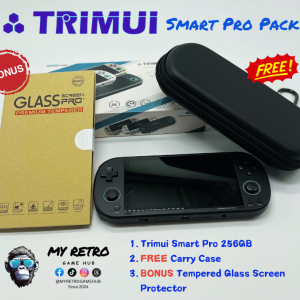
When I'm out and about, I carry my Trimui Smart Pro with me on the go, and let me tell you, I love this little guy. It's loaded with all my childhood games. And for those few missing titles, no worries—I just (legally) grab the ROM, load it onto the S.D. card, and boom, I'm back in action. Both the Kinhank and the Trimui is my go to for my nostalgic kick.

Retro Handheld - TriMui Smart Pro
Check out the TriMui Smart Pro—preloaded with over 12,000 retro games spanning multiple eras up to the PlayStation. This compact, portable device is your perfect companion for gaming on the go!
Special offer: Get a FREE carry case and screen protector with your purchase—while supplies last!
FREE DELIVERY WITHIN AUSTRALIA!
Read about The Birth of Nintendo or check out my other blogs - Click here.
Let's Connect on Social!


Some of the links on this site are affiliate links. If you click on one of the product links and then make a purchase, I may receive a small commission at no additional cost to you. Please know that I only recommend items I use and genuinely believe will benefit my readers. Your support through these affiliate partnerships helps me continue providing valuable content and keeping this site up and running. Thank you for your understanding and for being part of this community.