
Sony and Nintendo
In the early 1990s, during the 4th generation (16-bit) era, Nintendo and Sega were competing for market dominance with their consoles, the SNES and the MegaDrive/Genesis.
Both companies built a loyal user base; as of early 2023, Sega's total sales were close to 46.75 million, and Nintendo had sold about 111 million from the sales of its 8-bit and 16-bit consoles. They were riding high on their successes.

However, the games were transitioning from predominantly 2D graphics to the emerging world of 3D gaming. The transition to 3D gaming required significant advancements in both hardware and software.
Looking to innovate and expand the capabilities of its consoles, Nintendo sought to incorporate CD-ROM technology, which could offer greater storage capacity and multimedia capabilities than traditional cartridges.
Several CD-ROM-based systems entered the market in the late 1980s and early 1990s, bringing new capabilities and multimedia experiences to home gaming. While some of these systems were more successful than others, they collectively contributed to the industry's shift towards optical media, setting the stage for future consoles like the Sony PlayStation and Sega Saturn.
SEGA launched the Sega CD in the early 1990s. This add-on brought CD-ROM technology to SEGA's existing console, enabling larger game storage, improved audio, and full-motion video (FMV) sequences. Other systems from that era were already on the market, including the 3DO, Philips CD-i, and NEC TurboGrafx-CD.
Nintendo's plans for a CD-ROM drive for the SNES were already underway well before the SEGA CD was released. Nintendo and Sony have worked together since 1988, when Sony provided the S-SMP sound chip for the SNES, part of the console's audio subsystem. This chip was responsible for the SNES's high-quality sound and music capabilities, considered advanced for that era.
Ken Kutaragi, an engineer at Sony often referred to as the "Father of the PlayStation," designed the S-SMP sound chip for Nintendo's SNES around 1987-1988. This collaboration was significant in establishing a working relationship between Sony and Nintendo, eventually leading to the development of the SNES-CD project.
This collaboration extended to developing a CD-ROM add-on for the SNES to play cartridges and CD-ROM games. Initially referred to as the "Super Disc" or "SNES-CD," the system was to leverage Nintendo's gaming expertise and Sony's CD-ROM technology. The collaboration ultimately produced a prototype known as the "Nintendo PlayStation."
The initial negotiations included:
- Sony will produce the sound chip for the SNES
- Sony can develop a CD add-on for the SNES
- Sony can develop a hybrid SNES/CD-based console
- Sony will license all Super Disc games released

There were rumours of a prototype, but no one ever saw one until Terry Diebold discovered the Super Nintendo PlayStation at an abandoned property lot auction in 2009. Terry has toured classic gaming expos worldwide with his son, showing it to as many video game fans as possible. The system was sold for USD 360,000 in 2020.
The Betrayal
Before the Electronic Entertainment Expo (E3) became the premier event for the video game industry, the Consumer Electronics Show (CES) was a significant venue where video game companies showcased their products.
Sony announced the plans for the SNES drive at the 1991 CES. However, the next day after Sony's announcement, Nintendo surprised everyone by announcing a new partnership with Philips to develop a similar CD-ROM add-on. This announcement effectively ended the collaboration between Nintendo and Sony.
Nintendo executives realised they had made a mistake. As the deal stood, Nintendo would only profit from the hardware sales, while Sony would earn continuous income from all CD-based games.
The deal was tipped in Sony's favour, giving them substantial control over licensing and profits, which conflicted with Nintendo's stringent control over its game library and licensing policies. Additionally, there were disagreements over branding and market strategy.
Sony wanted to brand the new hybrid console as the "Play Station" and market it under their name, while Nintendo preferred to keep their brand at the forefront. Within Nintendo, there was significant resistance from some executives who were wary of giving too much power to Sony. These internal politics further complicated the relationship. Partnering with Philips offered more favourable terms and allowed Nintendo to maintain greater control over its intellectual property.
In 1992, Nintendo announced plans to manufacture and distribute a CD-ROM drive within a year at the CES. This announcement came a year after the public fallout with Sony and the new partnership with Philips. However, Nintendo never released its CD-ROM drive. The company faced delays and claimed the unit would be ready by August 1993. Behind the scenes, Nintendo was slowly closing down the project. By 1995, they were the only major game company without a CD-based console.
The Rejection
After the fallout with Nintendo, Sony made a similar proposal to Nintendo's rival, Sega. This collaboration aimed to leverage Sony's expertise in CD technology to create a new gaming platform.
Tom Kalinske, the CEO of Sega of America, was interested in collaborating with Sony. However, SEGA of Japan, where the final decision was made, was not very enthusiastic. Hayao Nakayama, the president of SEGA of Japan, rejected the idea, citing concerns about Sony's lack of experience in the gaming industry. Nakayama and other Japanese executives thought Sony lacked the necessary understanding and expertise for the specialised video game market.

Tim Kalinske, CEO of Sega of America - The SEGA PlayStation | Sonic and Sega Retro Forums.
"They said, 'That's a stupid idea, Sony doesn't know how to make hardware. They don't know how to make software either. Why would we want to do this?'"
After SEGA declined Sony's proposal to collaborate on a CD-based gaming console, Sony decided to proceed independently to prove Nintendo and Sega wrong.
After being let down by Nintendo and rejected by SEGA for a CD-based gaming console collaboration, Sony decided to proceed independently, determined to prove its capabilities beyond the expectations of both companies. Sony aimed to create a standalone gaming console.
Ken Kutaragi successfully convinced Sony CEO Norio Ohga to continue the project of surpassing the SNES with a next-generation gaming system.
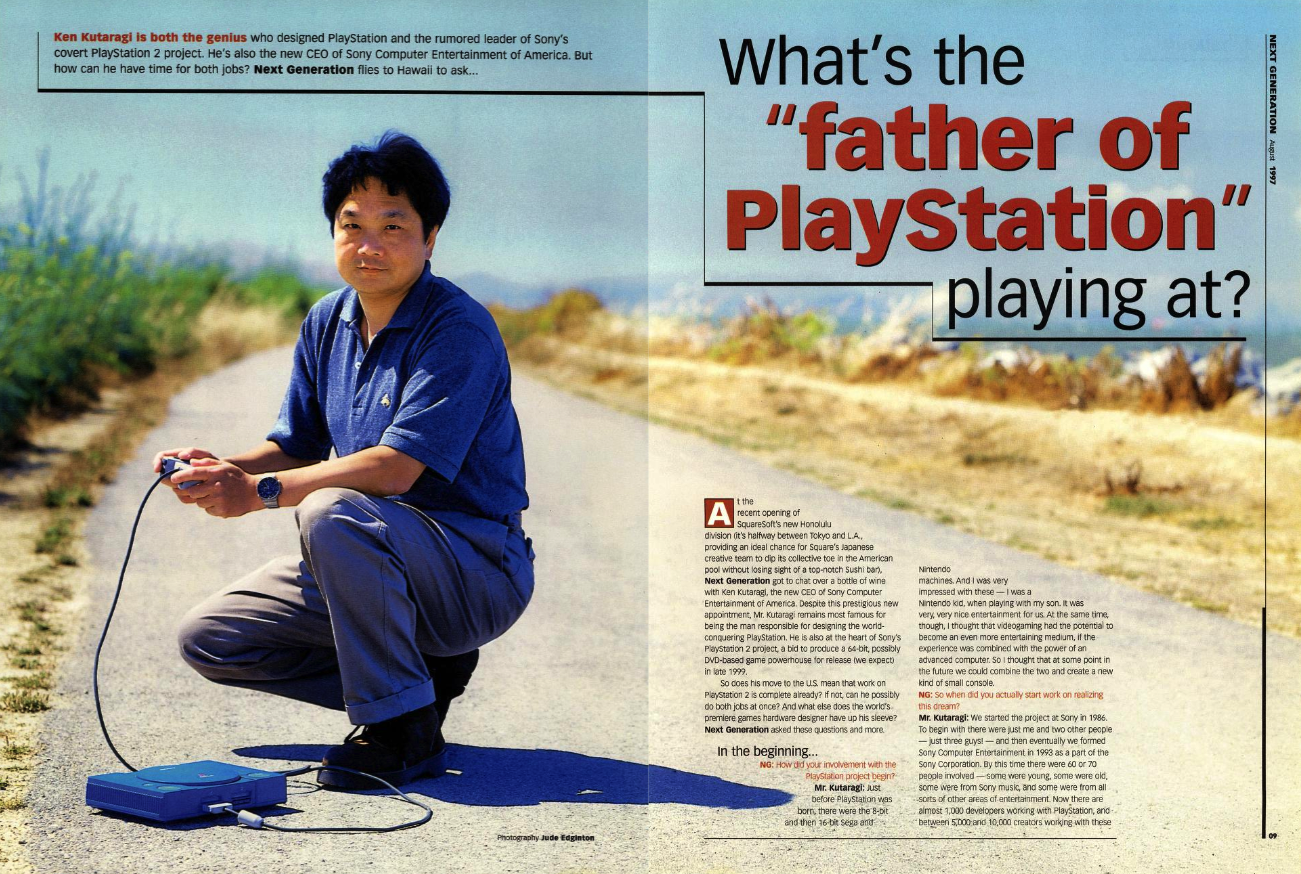
Ken Kutaragi, former Chairman and CEO of Sony Computer Entertainment aka 'Father of the PlayStation' - Next Generation, VOL.3-32 page 9, August 1997.
"... I thought that video gaming had the potential to become an even more entertaining medium if the experience was combined with the power of an advanced computer. So, I thought that at some point in the future, we could combine the two and create a new kind of small console."
Sony and Sega
On November 22, 1994, SEGA launched its new 32-bit video game console, the Saturn, in Japan. Not following the usual release schedule, the Launch occurred on a Tuesday, which added to the frustration of Tokyo commuters due to the overwhelming response to the Saturn.
Most stores sold out of pre-orders more than a month before Launch. Days before the release, lines formed at stores offering the Saturn on a first-come, first-served basis, but supplies fell far short of meeting the demand. The main draw was not the console but the arcade game Virtua Fighter, which was ported to the Saturn and sold separately at Launch.
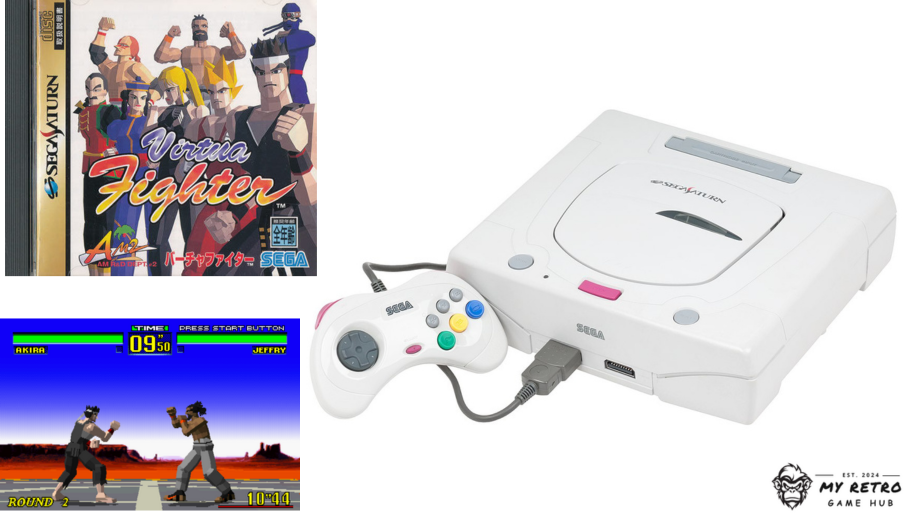
Virtua Fighter was revolutionary for its use of 3D polygon graphics. It received critical acclaim and was highly popular in arcades. Its success generated considerable anticipation for the SEGA Saturn release. All 200000 units were sold out on launch day.
Sony PlayStation was launched a week after the Sega Saturn in Japan on December 3, 1994, and was highly successful and marked a significant moment in gaming history. The combination of strong hardware, a solid lineup of games, and effective marketing helped the PlayStation quickly gain a foothold in the competitive gaming market. Sony sold approximately 100,000 PlayStation consoles on launch day. The initial solid sales reflected the high demand and anticipation for the new console, setting the stage for its future success in the global market.

Both companies employed distinctive marketing campaigns and slogans to capture gamers' attention during the PlayStation and Sega Saturn rivalry.
Both companies ran aggressive advertising campaigns, but Sony's efforts to appeal to a broader and older audience and their strategic partnerships with third-party developers helped the PlayStation gain a significant edge in the market.
Sony aggressively marketed the PlayStation with slogans like: "Do Not Underestimate the Power of PlayStation," emphasizing its superior 3D graphics, extensive game library, and developer-friendly architecture. Their campaigns often featured a bold and edgy tone aimed at capturing the attention of a broader and slightly older audience.
Sega promoted Saturn with slogans like "Sega Saturn: It's How You Play the Game," focusing on its arcade-quality graphics and performance. However, it struggled with its more complex hardware and limited third-party support.

Electronic Entertainment Expo
Over in the States, the first-ever Electronic Entertainment Expo (E3) was held at the Los Angeles Convention Center from May 11 to 13, 1995. This event began one of the most significant annual trade shows for the video game industry. All the major players in the game industry were ready to put on a show.
On day 1 of E3, Kalinske announced Saturn's launch price of 399 USD for the North American market, which, when adjusted for inflation, is equivalent to approximately 836 USD in today's currency. He described it as a powerful system before surprising everyone with the news that the console had already shipped to four major retailers: Toys R Us, Babbages, Software and Electronics Boutique.
On day 2 of E3, Sony announced its console. Everyone expected the price to be as high as or possibly higher than Saturn's. Steve Race, the CEO of Sony Computer Entertainment America, walked up to the podium, simply said, "$299," equivalent to 626 USD in today's currency, and then walked off the stage to thunderous applause from the audience. PlayStation's affordability compared to Saturn's was crucial in its widespread adoption and eventual dominance in the gaming market.
Another highlight of E3 was Nintendo discussing plans for a Nintendo 64 next-gen console, which was still in development. The company announced Virtual Boy, a portable virtual reality gaming console, to come out in August for a suggested retail price of 179 USD. The other big announcements were three Super NES games: Donkey Kong Country 2, Killer Instinct, and Yoshi's Island.
Sega Saturn's surprise launch at E3 in 1995 negatively impacted its sales and damaged relationships with key retailers. The early release led to limited availability, inadequate marketing hype, and higher prices than the PlayStation. Many major retailers, including Best Buy, Walmart, and KB Toys, were unprepared and frustrated by the lack of advance notice. They chose not to stock Sega products, further hurting its distribution and sales. This mishandling contributed to long-term perceptions of Sega as disorganized, ultimately hindering Saturn's success in the competitive gaming market.
Sony's surprise was more impactful. Although the Saturn came bundled with the highly desirable game Virtua Fighter, it was priced too high for a consumer electronics item. Consumers might be willing to pay such a price for a stereo component but not a video game console.
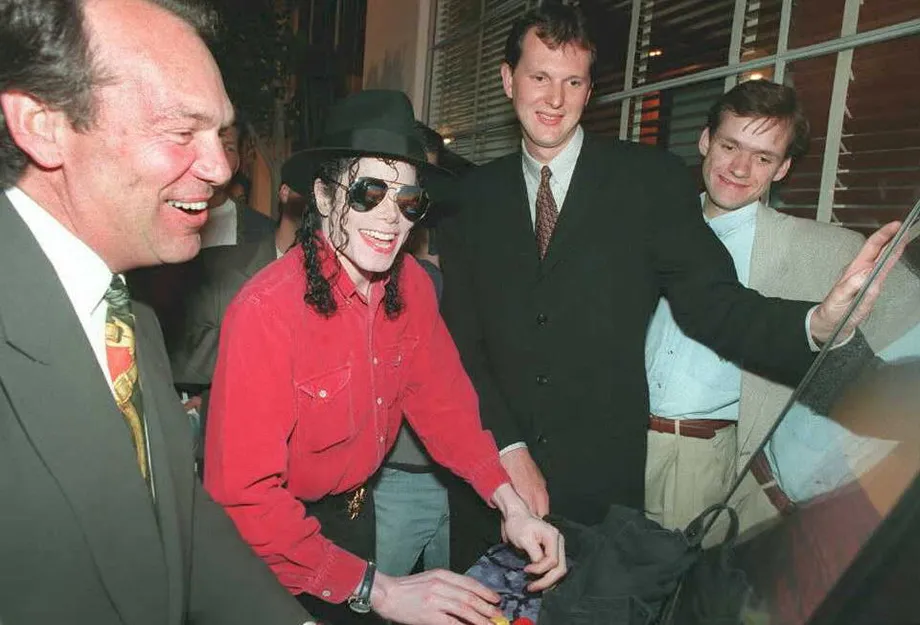
Michael Jackson with Sony executives, at Sony's E3 party in 1995 | Rene Macura/AFP/Getty Images
Steve Race is the CEO of Sony Computer Entertainment of America and a former Sega and Nintendo executive. The Ultimate History of Video Games Vol. 1 (New York: Three Rivers Press, 2001), p. 517.
"I'm sure that price came from Japan. Tom (Kalinske) was frequently dealt some very difficult cards to have to play, and he did a very good job of melding his deck and doing as much as he could with the cards that he was dealt. My hat is off to the guy."
North American Launch
Sony shipped 100,000 Playstation consoles for release on September 9, 1995, almost all pre-orders. As Race mentioned, the system was launched for 299 USD, approximately 626 USD in today's currency when adjusted for inflation. The entire shipment sold out.
The console was a massive success. It boasted impressive 3D graphics and a library of 12 games available at its American launch, making it far more appealing to Saturn's 6 Launch titles.
Two days after the release, Sony sold more PlayStations than Sega had sold Saturns in the five months since the surprise announcement at E3.
Sony took the lead, continuing to their European launch on September 29 and in Australia on November 15, 1995. There were 3 PlayStations for every Saturn sold in the UK. Within its first year, it had secured over 20% of the gaming market. By the end of 1995, it had already sold over 800,000 units in the US alone.
The Nintendo 64, released in 1996, struggled to compete with the PlayStation, which was dominating the gaming market. Despite Nintendo's claims that the N64 was the most advanced console, its decision to use cartridges instead of CD-ROMs, which promoted faster load times, proved disadvantageous. Cartridges' limited storage capacity restricted game complexity and prevented the inclusion of extensive video cutscenes, which were becoming standard on CD-based systems. It initially sold well but was ultimately overshadowed by the Sony PlayStation and eventual obscurity.
Games and Peripherals
A total of 7,918 games were released for the PlayStation 1, surpassing the Sega Saturn's library of 1,047 games and the Nintendo 64's library of 393 games. Developers favoured the PS1 due to its accessible architecture, which made game development easier. Sony's developer-friendly policies, lower licensing fees, quick approval process, and comprehensive development tools attracted many third-party developers, leading to the PS1's dominance in the fifth generation of gaming consoles.
The PlayStation's success was driven by groundbreaking games that introduced innovative concepts to the industry. "Final Fantasy VII" brought cinematic storytelling and immersive worlds, while "Metal Gear Solid" revolutionized the stealth genre with its intricate plot and advanced AI. "Gran Turismo" set new standards for realism in racing games, and "Resident Evil" pioneered the survival horror genre. Titles like "Tekken" and "Ridge Racer" showcased the PlayStation's 3D graphics capabilities, offering arcade-quality gameplay at home. These key games attracted a diverse audience and established the PlayStation as a leading gaming platform.

In April 1997, Sony in Japan launched the Dual Analog Controller, which offered two analog sticks and rumble. In November, it was replaced with the DualShock, which updated the thumbstick design and added the ability to click in, adding two extra buttons, L3 and R3, respectively, with rumble for all three region PlayStations. The PlayStation Multi-Tap was an accessory that allowed up to four players to connect their controllers to a single PlayStation console. It expanded multiplayer gaming possibilities beyond the standard two-player limit or even up to eight players with a second Multi-Tap.

In July 2000, Sony released a more compact and slimmer PlayStation known as the PS One, which could also be bought in a bundle with a screen to allow more portable play.
The PlayStation 1 had an incredibly long life as a console. It continued to be supported and sold well into the PlayStation 2's lifecycle. The PS2, released in March 2000 in Japan, maintained backward compatibility with PS1 games, which helped sustain interest in the older console.
The last official PlayStation 1 game was "FIFA Football 2005," released in 2004. This marked the end of the active game release period for the PlayStation 1, nearly a decade after the console's initial launch.
Additionally, new PS1 games were released until 2004, and the console itself was officially discontinued in March 2006, overlapping significantly with the PS2 era.
The PlayStation absolutely dominated the fifth generation of gaming consoles, shipping 102.49 million units, and it is considered the fifth best-selling console of all time.
One can only wonder what Sega and Nintendo thought as they witnessed Sony's meteoric rise. Given the PlayStation's enduring success and innovation, both companies might have pondered the missed opportunity to partner with Sony. The PlayStation brand's resilience and innovation are a testament to Sony's ability to turn early setbacks into monumental successes, shaping the future of gaming for decades.
Fast forward to today, the PlayStation brand continues to thrive with the PS5, released in November 2020. The PS5's advanced hardware, extensive game library, and backward compatibility have solidified its position in the current ninth generation of gaming consoles. The anticipation for the rumoured PS5 Pro, potentially launching in late 2024, underscores the ongoing evolution and relevance of the PlayStation brand. From the PS1's debut to the cutting-edge technology of the PS5, Sony's gaming consoles have continually pushed the boundaries of the gaming world, maintaining their legacy as industry leaders.
Stay Retro!
David - My Retro Game Hub
Read about The Birth of ColecoVision or check out more Gaming History.
Recommended Product

Retro Handheld - TriMui Smart Pro
Check out the TriMui Smart Pro—preloaded with over 12,000 retro games spanning multiple eras up to the PlayStation. This compact, portable device is your perfect companion for gaming on the go!
Special offer: Get a FREE carry case and screen protector with your purchase—while supplies last!
FREE DELIVERY WITHIN AUSTRALIA!
Let's Connect on Social!

-
3D Light-Up Wall Art – Demon Slayer Tanjiro
$170.00 -
3D Light-Up Wall Art – Dragon Ball Z – Goku Powering Up
$200.00 -
3D Light-Up Wall Art – Dragon Ball Z – Goku vs Majin Buu
$200.00 -
3D Light-Up Wall Art – Dragon Ball Z – Vegeta’s Sacrifice
$180.00 -
3D Light-Up Wall Art – Dragon Ball Z Super Saiyan Goku
$170.00
Some of the links on this site are affiliate links. If you click on one of the product links and then make a purchase, I may receive a small commission at no additional cost to you. Please know that I only recommend items I use and/or genuinely believe will benefit my readers. Your support through these affiliate partnerships helps me continue providing valuable content and keeping this site up and running. Thank you for your understanding and for being part of this community.