
Rise of the 4th-Generation
By the end of the 1980s, the Famicom/Nintendo Entertainment System (NES) had become well-known in households, captivating gamers with its extensive library of iconic games. Nintendo controlled approximately 80-90% of North America's home video game market.
However, the gaming industry was rapidly changing with the introduction of more powerful systems like NEC's P.C. Engine (TurboGrafx-16) and Sega's Mega Drive (Genesis), signalling a move towards more advanced, 16-bit gaming experiences.
The Competition
Nippon Electric Company (NEC) released the P.C. Engine in Japan in 1987, in North America in 1988, called Turbo Grafx-16, and in Europe in 1989. Despite having an 8-bit Hudson Soft CPU clocking at 7.16 MHz, it had a 16-bit graphics processor and 8 K.B. of RAM. Because of its powerful graphics capabilities, it is often mistaken for a 16-bit system.
This system provided significant graphical and sound improvements over Nintendo's 8-bit Famicom/NES, which featured a CPU clocked at 1.79 MHz (NTSC) or 1.66 MHz (PAL) and 2 K.B. of RAM.
In 1988, Sega released the Mega Drive in Japan, followed by its North American release as the Sega Genesis in 1989, and then in Europe in 1990. The system was a true 16-bit powerhouse featuring a Motorola 68000 CPU clocked at 7.67 MHz, a Zilog Z80 co-processor, 64 K.B. of RAM, and advanced graphics capabilities. It offered superior performance and visual quality compared to its 8-bit predecessors, bringing arcade-quality graphics to the living room.
Towards the end of the 1980s and early 1990s, Nintendo lagged behind the competition in technology, but amazingly, technology did not seem to matter. Super Mario Bros. 3 was released in Japan on the Famicom in October 1988 and on the NES in the United States in February 1990. Gamers were captivated by Mario's expanded world, making it one of the best-selling games of all time for an 8-bit system, selling over 17 million copies worldwide over its lifetime.

The Super Famicom
Nintendo began developing its 16-bit system in 1988 but was not in a rush to release it. Instead, they focused on developing high-quality hardware, prioritising visual and audio performance over processing power. With a rich history and many beloved characters, Nintendo updated its brand for the new generation and called it the Super Famicom (Family Computer).
The Famicom/NES was considered "old and dated," so they didn't need to worry about backward compatibility. This allowed them to market the new system as a newer and better version of what gamers already loved.
The system was a groundbreaking 16-bit video game console. The Super Famicom could handle 128 sprites simultaneously and display up to 4 layers on-screen at once. It featured a total palette of over 32,000 colours, with up to 256 colours visible at any given time, in contrast to Genesis's 512 colours and 64 on-screen. Equipped with a Sony stereo sound chip, it also boasted custom graphics chips that enabled eight distinct modes for graphics handling, including the renowned 'Mode 7 Graphics' for effects like scaling and rotating backgrounds.
When Nintendo announced the Super Famicom to the public in November 1988, fans eagerly awaited its release. Nintendo received close to 1.5 million pre-orders for the console.
The Super Famicom was launched in Japan on Wednesday, November 21, 1990. It was an international media event. The night before the launch, people lined up and waited outside stores. According to some reports, parents called in sick to work to join the shoppers' lines.
The streets of Tokyo were crowded with people, causing a slowdown. A frenzy erupted when news spread that Nintendo had only shipped 300,000 units. The pushing and shoving in the crowd prompted the Japanese government to later request that Nintendo and other video game companies avoid releasing their products on weekdays in the future. All the units were sold within 2 hours of its launch.

While American gamers were enjoying Super Mario Bros. 3 on the NES in the early 1990s, Japanese gamers were already experiencing the newly released Super Mario World (Super Mario Bros. 4) on the Super Famicom. This overlap highlighted the different stages of console evolution in the two regions at that time.
North America received Nintendo's 16-bit console ten months after its Japanese debut, on September 9, 1991, under the new name Super Nintendo Entertainment System (SNES).
Lance Barr, an industrial designer at Nintendo who had previously worked on the design of the NES and the NES Advantage joystick, felt that the design of the Super Famicom looked too soft and resembled "a bag of bread," which he found bland. In response, he redesigned the console to look squarish and blocky. This redesign aimed to appeal to American consumers who preferred a sturdier and more robust look.
Anticipation within the gaming community reached new heights, fueled by the success of Super Mario Bros. 3, which heightened the demand for more advanced gaming experiences. The upcoming SNES launch, with its 16-bit graphics and improved hardware, significantly increased excitement. Nintendo quickly sold out its entire shipment of 1 million consoles upon release.
In 1991, the Sega Genesis had already established a strong U.S. presence with its aggressive marketing and the slogan "Genesis does what Nintendon't." Sega released Sonic The Hedgehog in June 1991, two months before the SNES debuted in the U.S. Sonic's success revitalized interest in the Genesis, providing it with a strong mascot and flagship title, boosting sales, and positioning Sega as a formidable competitor. It also intensified the rivalry between Sega and Nintendo.

Super Famicom and Super Nintendo Entertainment System (SNES)
Fun Fact: In South Korea, the SNES console was distributed by Hyundai and renamed the Super Comboy due to a ban on Japanese products. Similarly, Sega's Genesis was distributed by Samsung and rebranded as the Super Aladdin Boy.
Winning the Market: Games That Drove Console Sales
When Nintendo released the SNES, Sega had already been on the market for two years and had an extensive library of 150 games compared to Nintendo's 12. Sega also reduced Genesis's price to $150, making it more attractive to consumers than SNES's $199.
Bundled with the SNES at launch, Super Mario World showcased the system's capabilities. It significantly contributed to its early success, driving initial sales. In later years, other bundled games such as The Legend of Zelda: A Link to the Past, Super Mario All-Stars, and Donkey Kong Country also boosted sales.
Nintendo secured exclusive console rights to games developed by Capcom, such as Final Fight and Street Fighter II. Final Fight was released on the SNES in 1991, and Street Fighter II: The World Warrior was released in June 1992. Both these games were massive successes and significantly boosted sales and the popularity of the SNES.
Sega released its version of Street Fighter II for the Genesis almost a year later, Street Fighter II: Special Champion Edition, in September 1993. By then, the SNES version of Street Fighter II had already built a strong presence in the market, helping to give the SNES a competitive edge.

Meanwhile, NEC struggled to stay afloat with its SuperGrafx-16 despite being the first to introduce a CD-ROM add-on, the TurboGrafx-CD, and the portable TurboExpress. To remain competitive, they also lowered their console's price to $99.
Sega targeted the teenage and older demographics by presenting its system as cooler than Nintendo's. On the other hand, Nintendo focused on being more family-friendly, featuring adorable characters like Mario, Kirby, and Zelda.
Sega released games with mature themes, fast-paced action, and edgier content, such as Mortal Kombat and Road Rash, appealing to older gamers seeking a more intense experience. In contrast, Nintendo censored their games, for example, toning down the violence in Mortal Kombat by replacing blood with 'sweat' and making the Fatalities (finishing moves) less violent.
The censorship of "Mortal Kombat" led gamers to favour the uncensored Sega Genesis version over the SNES version, reinforcing the perception that Nintendo catered to a younger audience. This gave Sega a competitive edge and helped bolster its "cool" and edgy image.

Aggressive Marketing Campaign
In 1992, Sega had several advantages over Nintendo. Besides a lower price and a more extensive game library, Sega was faster at releasing new games. Early Nintendo releases were not as enjoyable, and anticipated titles were slow to arrive. Sega offered a wider variety of games, and their quality was improving. Sega also produced games faster, providing Genesis owners with more options and excitement, while SNES owners often had to wait longer for new releases.
Sega's marketing campaigns evolved from the early "Genesis Does What Nintendon't" slogan, initially targeting the NES, to adopting an energetic, loud, and edgy underground image with the "Sega Scream" in their commercials. Later, in 1993, they introduced the "Blast Processing" campaign to suggest to consumers that the Genesis had superior processing power and speed compared to the SNES.
Nintendo's advertising was caught in a Mario-esque world of cute images appealing to preteen kids. This positioning made Sega the cooler choice among high school students, leading to fewer people openly admitting their preference for Nintendo. A Sony marketing study even found that teenage boys who owned an SNES console were reluctant to admit it.

Tom Kalinske, CEO of Sega of America. - The Ultimate History of Video Games Vol. 1 (New York: Three Rivers Press, 2001), p. 449.
"I saw that our primary audience was over eighteen years of age. Nintendo tended to focus on younger kids. We attempted to focus on an older crowd. Forty percent of our business is over eighteen years old. Teenage and college-age kids have adopted the Sega Scream. I was backstage at a rap concert, and I watched rappers who did not know who I was meet each other with the Sega Scream."
Nintendo decreased the price of the SNES multiple times to stay competitive. One notable reduction occurred a year after the SNES launched in 1992, going from $199 to $149 to compete with the Sega Genesis. Nintendo of America Vice President of Marketing, Peter Main, later commented that they could have sold an extra million consoles if they had gone with the $149 price tag at launch.
Sega responded to Nintendo's price drop by reducing the Genesis from $150 to $129.
Nintendo launched its campaign to counter Sega's aggressive marketing, using slogans like 'Now You're Playing with Super Power' to highlight the advanced capabilities of their new console. In the mid-1990s, they introduced the 'Play It Loud' campaign, which targeted an older, more mature audience. With its aggressive and rebellious themes, this campaign contrasted with Sega's edgy marketing. It aimed to demonstrate that Nintendo could also be cool and appealing to teenagers.
By the mid-1990s, NEC gradually dropped out of the 16-bit console wars due to intense competition from Sega and Nintendo, limited third-party support, less effective marketing and the relatively high cost of its hardware.
The CD-ROM Race
In the early 1990s, companies aimed to differentiate their consoles by incorporating advanced technology as the gaming market grew increasingly competitive. CD-ROM add-ons were developed to offer more sophisticated and appealing gaming experiences and enhance their consoles' capabilities.
CD-ROMs were cheaper to produce, supported high-quality audio and had over 100 times more storage capacity than a typical cartridge.
NEC's P.C Engine was the first to release a peripheral with its TurboGrafx-CD as early as 1988 in Japan and 1990 in North America. The system found some success in Japan, but it faced significant challenges in North America, ultimately leading to its decline as newer, more advanced consoles emerged.

NEC TurboGrafx-CD
Sega released the Sega CD (the Mega CD in Japan) in 1991, followed by its North American debut a year later as an add-on for the Genesis. This 32-bit peripheral significantly increased storage capacity to 320 times that of cartridges and enhanced audio and full-motion video (FMV). However, the Sega CD struggled due to its high cost, limited game library, and competition from other technologies, highlighting both the potential and challenges of integrating CD-ROM technology into home gaming consoles. Ultimately, the Sega CD was considered a failure, selling only 2.2 million units compared to the parent console, the Genesis, with over 30 million units sold.

Sega/Mega CD
In the early 1990s, Nintendo and Sony planned to create a CD-ROM add-on for the SNES called the "Super Disc" or "Nintendo Play Station." However, disputes over control and licensing agreements led to a fallout in the partnership in 1991. Nintendo then announced a new partnership with Philips, which resulted in the cancellation of the joint project.
Sony was undeterred and leveraged their work and technological advancements to develop their standalone console. This decision ultimately led to the release of the original PlayStation in 1994, which became a massive success and established Sony as a major player in the gaming industry. This effectively changed the landscape of video gaming for years to come.
The "console wars" of the 1990s, particularly between Sega and Nintendo, didn't have a definitive endpoint but transitioned as new competitors emerged and the market evolved.
After Nintendo and Sony's failed collaboration, several notable CD-ROM-based fifth-generation consoles (32-bit) were released throughout the 1990s up to the turn of the millennium.

The New Challengers
New systems like the Philips CD-i (1991), the 3DO Interactive Multiplayer (1993), and the Amiga CD32 (1993) entered the market but failed to gain significant traction. The Atari Jaguar and Neo Geo CD (1994) also appeared in the industry but were discontinued towards the end of the 1990s.

Sega attempted to extend the life of the Genesis by releasing the 32X in 1994. This mushroom-shaped device could be attached to the Genesis cartridge slot. It claimed to provide the system with 32-bit processing power, making it run 40 times faster. However, due to poor timing, a limited game library, and a confusing market strategy, the 32X failed to gain traction. The rapid advancement of gaming technology and the release of next-generation consoles ultimately led to its discontinuation in 1996, with only 800,000 units sold, considering it a commercial failure.

The successor to the Sega Genesis was the Sega Saturn, released in 1994 in Japan and 1995 in North America and Europe. With its 32-bit architecture, the Sega Saturn was a fifth-generation console marked by transitioning from 2D to 3D graphics and CD-ROMs over cartridges. The Saturn was set to compete with Sony's PlayStation and the upcoming Nintendo 64 that year. Despite its advanced hardware and strong initial sales in Japan, the Saturn faced challenges due to a rushed and poorly executed launch in North America, including a surprise early release that caught retailers and developers off guard.
Saturn's complex architecture made game development difficult, leading to a lack of third-party support and a limited game library. Combined with Sega's fragmented marketing strategy and the overwhelming success of the PlayStation, the Saturn failed to gain significant traction in the market. Due to Sega's poor communication, Walmart and Best Buy refused to stock their systems on their shelves.
By 1998, Sega had discontinued the Saturn, selling only about 9.3 million units worldwide, marking it as another commercial failure. In comparison, the Nintendo 64 sold 33 million units, while the original Sony PlayStation reached 102.4 million units in sales.

Sega's final attempt to reclaim its position in the console market was the release of a 6th-gen console, the Sega Dreamcast, in 1999. This console was considered ahead of its time, boasting innovative features such as online connectivity and a robust library of games. Despite its initial success, it struggled due to limited third-party support and competition from the Sony PlayStation 2 and Microsoft Xbox. Sega discontinued the Dreamcast in 2001 after selling around 9.1 million units worldwide, compared to 24 million units for the Xbox and a massive 155 million units for the Sony PlayStation 2. With yet another failure, Sega lost over 200 million dollars in the last year of the Dreamcast alone.

Nintendo was the only major video game company without a CD-based system in the 1990s. The company eventually released the Nintendo GameCube after the turn of the millennium, at the beginning of the sixth-generation console era, launching it in Japan and North America in 2001, followed by Europe in 2002.
The rivalry between Sega and Nintendo pushed gaming boundaries. It shaped today's industry and defined a crucial chapter in video game history. Overall, with all its variants, the Genesis sold 35 million units; the SNES still had the upper hand with over 49 million units.

After the Dreamcast's commercial failure, Sega exited the hardware business and announced it would no longer develop its own consoles. Instead, Sega transitioned to a third-party developer and publisher, creating games for other platforms. This shift allowed Sega to work with former rivals like Sony, Microsoft, and Nintendo, leveraging its popular franchises, such as Sonic the Hedgehog, on a broader range of systems and remaining a significant player in the video game industry.
Stay Retro!
David - My Retro Game Hub
Read about The Birth of Nintendo or check out my other blogs - Click here.
Recommended Product

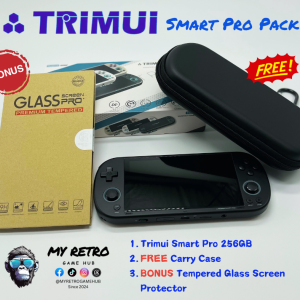
Retro Handheld - TriMui Smart Pro
Check out the TriMui Smart Pro—preloaded with over 12,000 retro games spanning multiple eras up to the PlayStation. This compact, portable device is your perfect companion for gaming on the go!
Special offer: Get a FREE carry case and screen protector with your purchase—while supplies last!
FREE DELIVERY WITHIN AUSTRALIA!
Let's Connect on Social!




Some of the links on this site are affiliate links. If you click on one of the product links and then make a purchase, I may receive a small commission at no additional cost to you. Please know that I only recommend items I use and/or genuinely believe will benefit my readers. Your support through these affiliate partnerships helps me continue providing valuable content and keeping this site up and running. Thank you for your understanding and for being part of this community.