
When discussing the roots of console gaming, names like Atari, Nintendo, and Sega often dominate the conversation. However, before these giants made their mark, the gaming landscape was shaped by a series of lesser-known yet equally significant pioneers. While Bandai's more famous ventures like the Bandai Pippin and Playdia are discussed in my previous blogs, it's easy to overlook one of their earliest forays into the gaming world: the Bandai TV Jack series.

In this blog post, we'll explore the development, specifications, and legacy of the Bandai TV Jack consoles—devices that, while not as impactful as some of their successors, played a crucial role in the early days of home gaming.
The Genesis of the TV Jack Consoles
Let's rewind back to the year 1977, a time when the home video game market was in its infancy. Inspired by the success of the Magnavox Odyssey and the emerging popularity of Pong clones, Bandai, already an established toy manufacturer, decided to venture into the burgeoning video game market. The result was the TV Jack series, a line of dedicated home consoles designed to bring the arcade experience into Japanese living rooms.
The development of the TV Jack series was a reflection of the technological trends of the time. Like many early consoles, the TV the success of Pong heavily influenced Jack. Pong clones were all the rage, and playing a video game on your television was still a novel concept. Bandai sought to capitalise on this trend by creating a series of consoles that were easy to use, affordable, and appealing to a broad audience.
The first unit in the series, the TV Jack 1000, was released in 1977. The console was a simple, no-frills device that offered a single Pong-style tennis game. Subsequent models followed each offering slightly more advanced features and additional games. The series included the TV Jack 1200, TV Jack 1500, TV Jack 2500, TV Jack 3000, and the TV Jack 5000, each iteration building upon the last in terms of capability and design.
The TV Jack Series
Despite being relatively primitive by today's standards, the TV Jack series was quite advanced for its time.
Let's examine the specifications of these pioneering consoles.
TV Jack 1000
- Processor: No dedicated CPU; the logic for the game was hardwired into the console.
- Games: Pong (Tennis)
- Controller: Two built-in paddle controllers
- Display: Monochrome (black and white)
- Output: RF output for connection to a TV
The TV Jack 1000 was a straightforward device with minimal features, designed to do one thing: play Pong. It was a direct competitor to other Pong clones on the market, offering Japanese consumers a homegrown option.

TV Jack 1200 and 1500
- Games: The TV Jack 1200 introduced a few variations of Pong, including Soccer and Squash. The TV Jack 1500 added more variations, such as Hockey and Practice mode.
- Controllers: Still paddle-based but with detachable controllers in the later models.
- Display: Monochrome
The 1200 and 1500 models were iterative improvements over the original 1000, offering more game modes and slightly better controllers. These versions were designed to keep up with the competition, which also incrementally improved their offerings.


Bandai TV Jack 1200 Gameplay
TV Jack 2500 and 3000
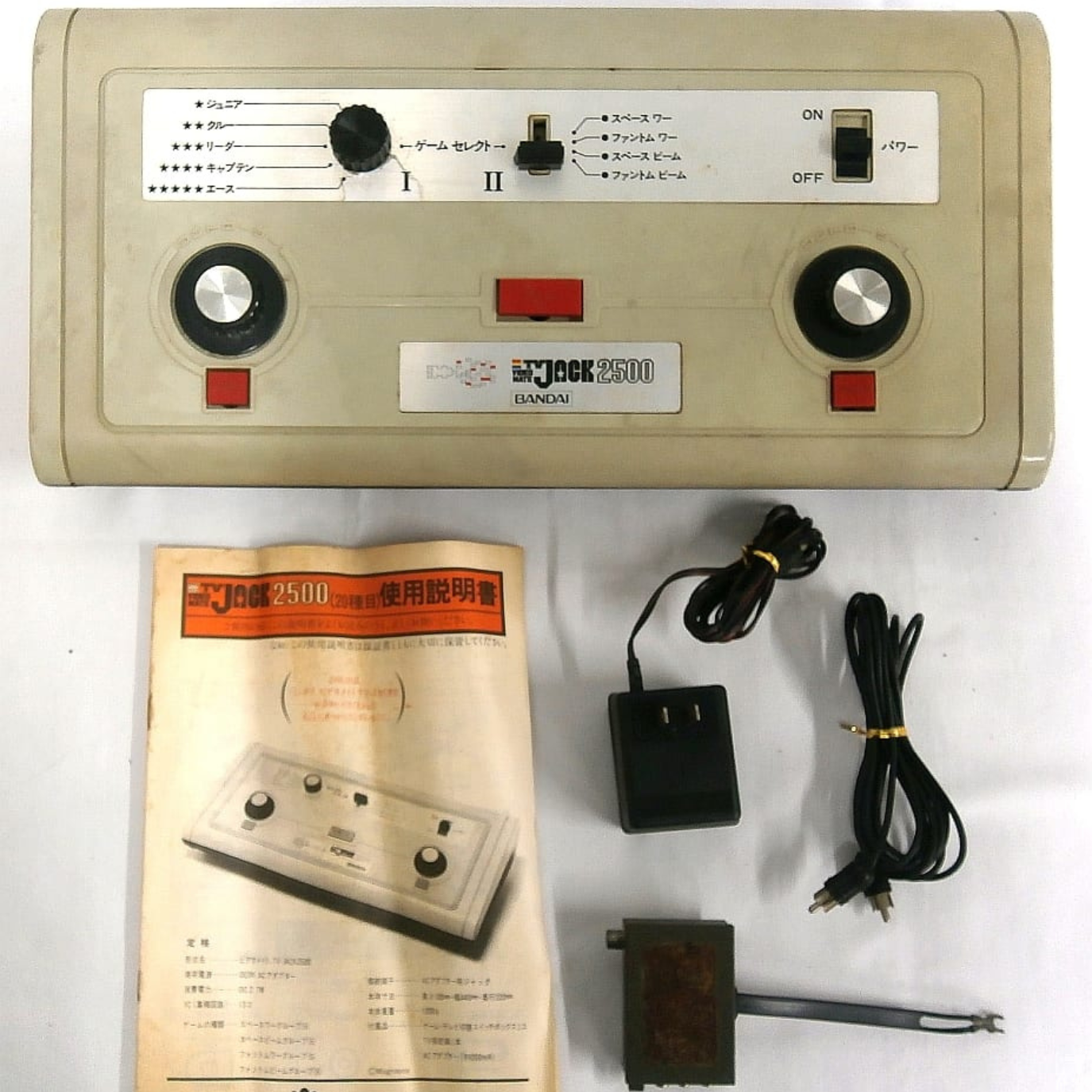
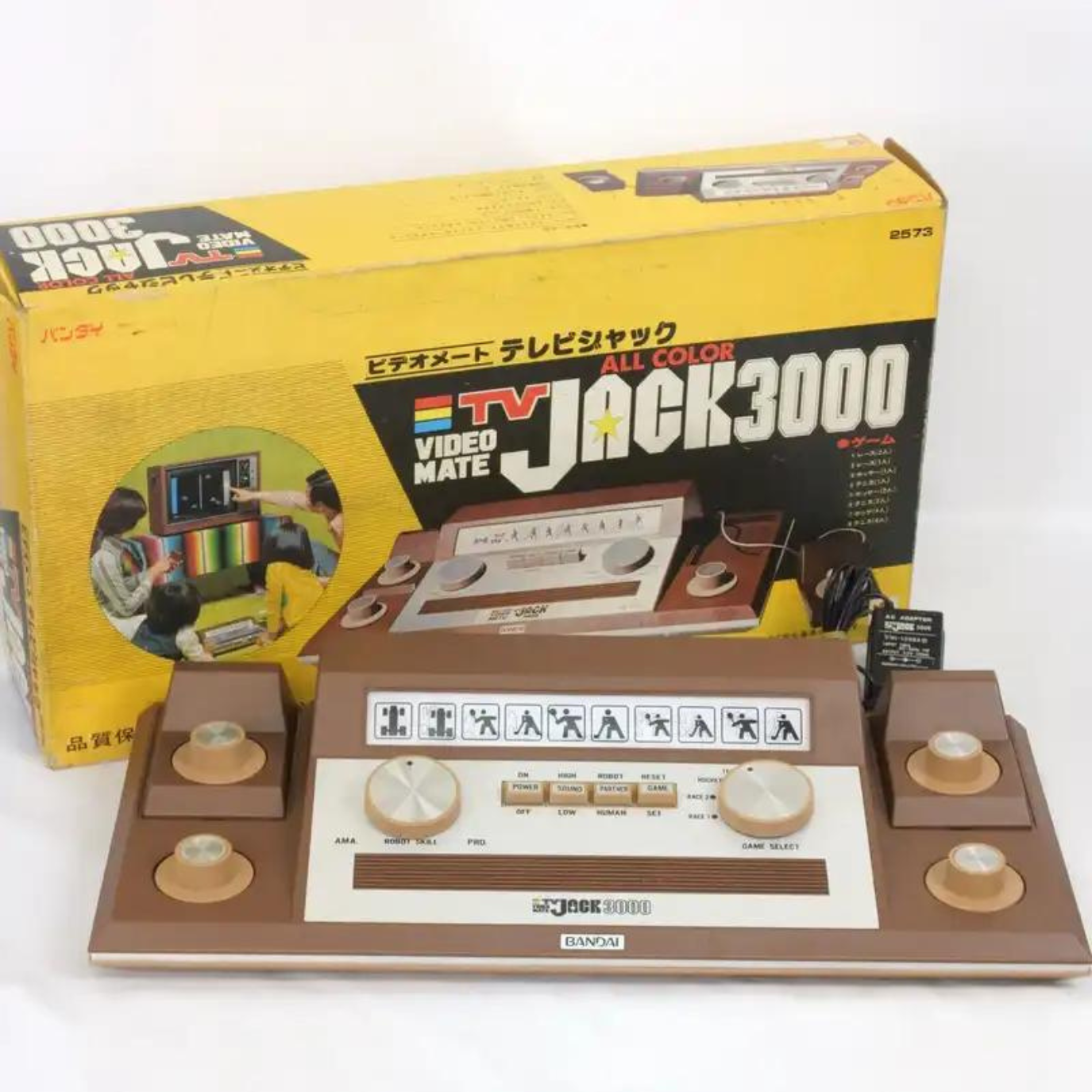
The 2500 and 3000 models represented Bandai's attempt to diversify the gaming experience beyond simple Pong clones. The introduction of different games and input devices showed Bandai's willingness to innovate and explore new possibilities in gaming.
Bandai TV Jack 2500 Gameplay
TV Jack 5000
In my exploration of the Bandai TV Jack series, it's crucial to include the final consoles in this pioneering line: the Bandai TV Jack 5000 and 8000. These consoles represented both the culmination of Bandai's early efforts in the video game industry and the end of the TV Jack series.
While the earlier models in the series laid the groundwork, the TV Jack 5000 stands out as Bandai's most ambitious attempt to bring advanced gaming experiences into Japanese homes during the late 1970s. Unlike its predecessors, which only had built-in games, the TV Jack 5000 introduced cartridge support, aligning it with the emerging trend of expandable game libraries in consoles like the Atari 2600.
At its launch in 1978, the Bandai TV Jack 5000 retailed for ¥19,800, approximately USD 80 at the time (equivalent to about USD 400 when adjusted for inflation to 2024). This pricing made it more accessible than the later, more advanced TV Jack 8000 (Super Vision 8000), which was significantly more expensive. The TV Jack 5000 was designed to be more powerful and feature-rich than its predecessors, distinguishing itself with enhanced hardware and a broader variety of games.

Let's take a closer look at what made this console unique:
- Processor: Like the earlier models, the TV Jack 5000 did not have a dedicated CPU in the modern sense, but it utilised more complex circuitry to manage multiple game types and more sophisticated gameplay.
- Games: The TV Jack 5000 came with six games, expanding beyond the simple Pong variants of earlier models. The Bandai TV Jack 5000 cartridges were inserted parallel to the console's front face. The cartridge would slide into the slot so that it lay flat, parallel to the console's surface, with the label typically facing upward. Games included:
- Tennis (a more advanced version of Pong)
- Soccer
- Squash
- Shooting (using the light gun peripheral)
- Practice mode
- A car racing game (using a steering wheel peripheral)
- Controllers: One of the standout features of the TV Jack 5000 was its detachable controllers, which included paddles, a light gun, and a steering wheel. This variety in input devices allowed for a more diverse gaming experience, which was relatively uncommon at the time.
- Display: The TV Jack 5000 supported both monochrome and colour displays, depending on the TV it was connected to, making it more versatile than earlier models that were strictly monochrome.
- Output: The console is connected to the television via an RF output, typical of consoles from that era.
The inclusion of peripherals like the light gun and steering wheel was particularly noteworthy, as it indicated Bandai's interest in exploring different types of interactivity beyond the simple paddle controllers that dominated the early console market.
A model known as the Bandai TV Jack 5000 II was released shortly after the original, around a year later, in 1979. This was an updated version of the original TV Jack 5000, but it wasn't an entirely new console. It was a slight revision of the existing one. It retained the same six games and used the same peripherals (paddle controllers, light guns, and steering wheel). There were no significant changes in the game library or the console's functionality.
The release of the TV Jack 5000 II was likely aimed at extending the life of the TV Jack series in the market as Bandai began developing their next console, the TV Jack 8000. At the time, it was common practice for companies to release minor revisions of their consoles to fix issues or slightly improve the user experience without developing an entirely new system.

Bandai TV Jack 5000 Gameplay
The Super Vision 8000
The Bandai TV Jack 8000 was the final console in the TV Jack series. It represented Bandai's most advanced effort in home video gaming.
The development of the console began in 1978, and it was the first console to support ROM cartridges. Despite having no prior experience with such technology, Bandai invested heavily in research and development. After a year, the console was unveiled at the Tokyo International Toy Fair under the new name, Super Vision 8000, though no games were announced at the time. An optional keyboard was also planned to transform the console into a computer.
Released in December 1979, the Super Vision 8000 launched with only one game, Missile Vader, and a hefty price tag of ¥59,800, approximately USD 220 at the time (equivalent to about USD 1200 when adjusted for inflation to 2024) due to the high R&D costs. Although the pricing was similar to the Epoch Cassette TV Game (a rebranded Atari 2600), it was nearly double that of other systems.
- Processor: The TV Jack 8000 was powered by a 4-bit NEC D780C microprocessor, a variant of the Zilog Z80, a popular CPU at the time.
- Graphics and Sound: The console offered improved graphics and sound capabilities compared to its predecessors. It boasted a resolution of 256x192 pixels and supported up to 8 colours. It also featured a sound chip that could generate simple tones and noise for game audio.
- Input: The console came with a distinctive keyboard, which allowed. It allowed for more complex gameplay and a broader range of software beyond games.
- Software and Games: The TV Jack 8000 was compatible with game cartridges but also supported educational and other software, reflecting a shift towards more multifunctional home computers. Despite this versatility, the game library was relatively small, and the system struggled to compete with more established gaming consoles and emerging home computers.
Bandai marketed the console on the promise of cheaper games with unlimited potential via the new ROM format. However, the limited number of available games hindered sales, creating a vicious cycle where low sales discouraged further game development. Despite Bandai releasing six additional games (seven in its short lifespan), the console never gained enough traction to succeed. Despite being a reasonably capable piece of hardware, the Super Vision 8000 was simply too expensive.

The Impact and Legacy of the TV Jack Series
Despite its enhanced features and broader game variety, the TV Jack 5000 and 8000 did not achieve the commercial success Bandai had hoped for. By the time of its releases, the market was already shifting towards more advanced, cartridge-based systems that offered a wider array of games and better graphics. The rapid evolution of gaming technology meant that dedicated consoles like the TV Jack series were quickly becoming obsolete.
The TV Jack 5000 sold modestly in Japan, but it failed to make a significant impact. The TV Jack 8000, despite its advanced features, struggled with poor sales due to its high price, limited game library, and strong competition.
However, it did serve as an important stepping stone for Bandai, helping the company to refine its approach to video game development and market positioning. The lessons learned from the TV Jack series would inform Bandai's later efforts in the gaming industry, including developing more complex systems like the Bandai Pippin and the Bandai Playdia.

In retrospect, the Bandai TV Jack 8000 represents the end of an era—both for Bandai and the early days of dedicated home gaming consoles. The console was part of the final wave of pre-cartridge systems when manufacturers were still experimenting with how best to bring the arcade experience into the home.
Although the TV Jack series was not a game-changer in the industry, it did contribute to the broader understanding of what home consoles could offer. The inclusion of multiple types of games and peripherals demonstrated that there was a demand for more interactive and varied gaming experiences. This concept of expanding gameplay possibilities through different input methods would later be fully realised in more advanced consoles that followed.
Furthermore, the TV Jack's attempt to offer a more comprehensive gaming package—combining sports, shooting, and racing games—can be seen as a precursor to the multi-genre game libraries that became standard in subsequent generations of consoles.
The Legacy and Impact
So, what impact did the TV Jack series have on the gaming industry? To answer that, we need to consider the context in which these consoles were released and their role in the larger narrative of video game history.
The Bandai TV Jack series was moderately successful in Japan, particularly in the late 1970s. While it didn't achieve the same level of success as some of its Western counterparts, it did establish Bandai as a player in the video game market. The series sold well enough to justify multiple iterations, and it helped familiarise Japanese consumers with the concept of home video gaming.
However, the TV Jack's success was short-lived. By the early 1980s, the market shifted towards more advanced, cartridge-based systems like the Nintendo Famicom (NES) and the Sega SG-1000. These new consoles offered a much more versatile and expansive gaming experience than the TV Jack series could provide. As a result, the TV Jack consoles quickly became outdated, and Bandai shifted its focus to other ventures.
While the TV Jack series may not have had a lasting commercial impact, it contributed to video games' technological evolution. The various models in the series experimented with different types of games and input devices, such as light guns and steering wheels. These experiments laid the groundwork for future gaming peripherals and interaction methods developments.
Moreover, the TV Jack series demonstrated the potential of home video gaming in Japan, paving the way for the industry's explosive growth in the 1980s and beyond. It showed that there was a market for video games outside of arcades, a realisation that would be fully capitalised upon by companies such as Nintendo and Sega.

A Historical Footnote, Yet a Pioneer
Today, the Bandai TV Jack series is largely a historical footnote, overshadowed by the more successful and influential consoles that came after it. However, for those of us who are passionate about the history of video games, the TV Jack represents an important chapter in the story of how home gaming evolved. It was an early attempt to bring the arcade experience into the home, and while it wasn't revolutionary, it was a crucial step in the journey that led to the vibrant gaming industry we know today.
To fully appreciate the Bandai TV Jack series and its place in gaming history, it's important to understand that Bandai was pioneering in its own right and highly collaborative. Throughout its history, Bandai has frequently partnered with other industry giants to push the boundaries of gaming and technology. From its later partnership with Apple on the ill-fated Pippin to its collaborations with Nintendo, Sony, and Namco, Bandai has consistently sought to innovate by leveraging the strengths of its partners. These collaborations helped Bandai transition from simpler, dedicated consoles like the TV Jack series to more complex and versatile systems, ultimately shaping its long-term strategy in the gaming industry. This spirit of collaboration has been a defining characteristic of Bandai's approach, allowing the company to remain relevant and influential even as the gaming landscape has evolved.

In the grand tapestry of video game history, the Bandai TV Jack series may not loom large, but it deserves to be remembered. It was a product of its time—an era when the idea of playing video games at home was still novel and exciting. The TV Jack series was Bandai's severe first foray into the video game market, and it laid the foundation for the company's future endeavours in gaming.
For collectors and enthusiasts, the TV Jack is a fascinating piece of gaming history. It represents the early days of an industry that would become a global cultural phenomenon. While the games themselves may be simple by today's standards, the legacy of the TV Jack series lies in its role as a pioneer—a console that helped shape the future of home gaming, even if it has since been largely forgotten.
The next time you're discussing the history of video games, spare a thought for the Bandai TV Jacks. It may not have been the most influential console of its time, but it was an important stepping stone in the medium's evolution. And for that, it deserves its place in the annals of video game history.
Stay Retro!
David - My Retro Game Hub
Read about The Birth of Nintendo or check out my other blogs - Click here.
Recommended Product

Retro Handheld - TriMui Smart Pro
Check out the TriMui Smart Pro—preloaded with over 12,000 retro games spanning multiple eras up to the PlayStation. This compact, portable device is your perfect companion for gaming on the go!
Special offer: Get a FREE carry case and screen protector with your purchase—while supplies last!
FREE DELIVERY WITHIN AUSTRALIA!
Let's Connect on Social!





Some of the links on this site are affiliate links. If you click on one of the product links and then make a purchase, I may receive a small commission at no additional cost to you. Please know that I only recommend items I use and genuinely believe will benefit my readers. Your support through these affiliate partnerships helps me continue providing valuable content and keeping this site up and running. Thank you for your understanding and for being part of this community.